④ Track 2: Letting the Simulator Teach the Hand to Roll Walnuts
Part 4 of the series · Previous ③ · Overview · Next: ⑤ Baoding sim-to-real and lessons
Track 2's brief is "rolling walnuts": like baoding balls, make two small balls circle each other in the palm. We took it on at 15:08 on September 5, still riding the high of the teleoperation working — and from then on every training run learned to hold and almost none learned to rotate. This part writes down the nine experiments, why each was scrapped, and the September 8 realisation that "the hand was pointing the wrong way". This is a tutorial in progress — the mount-angle sweep at the end is still running.
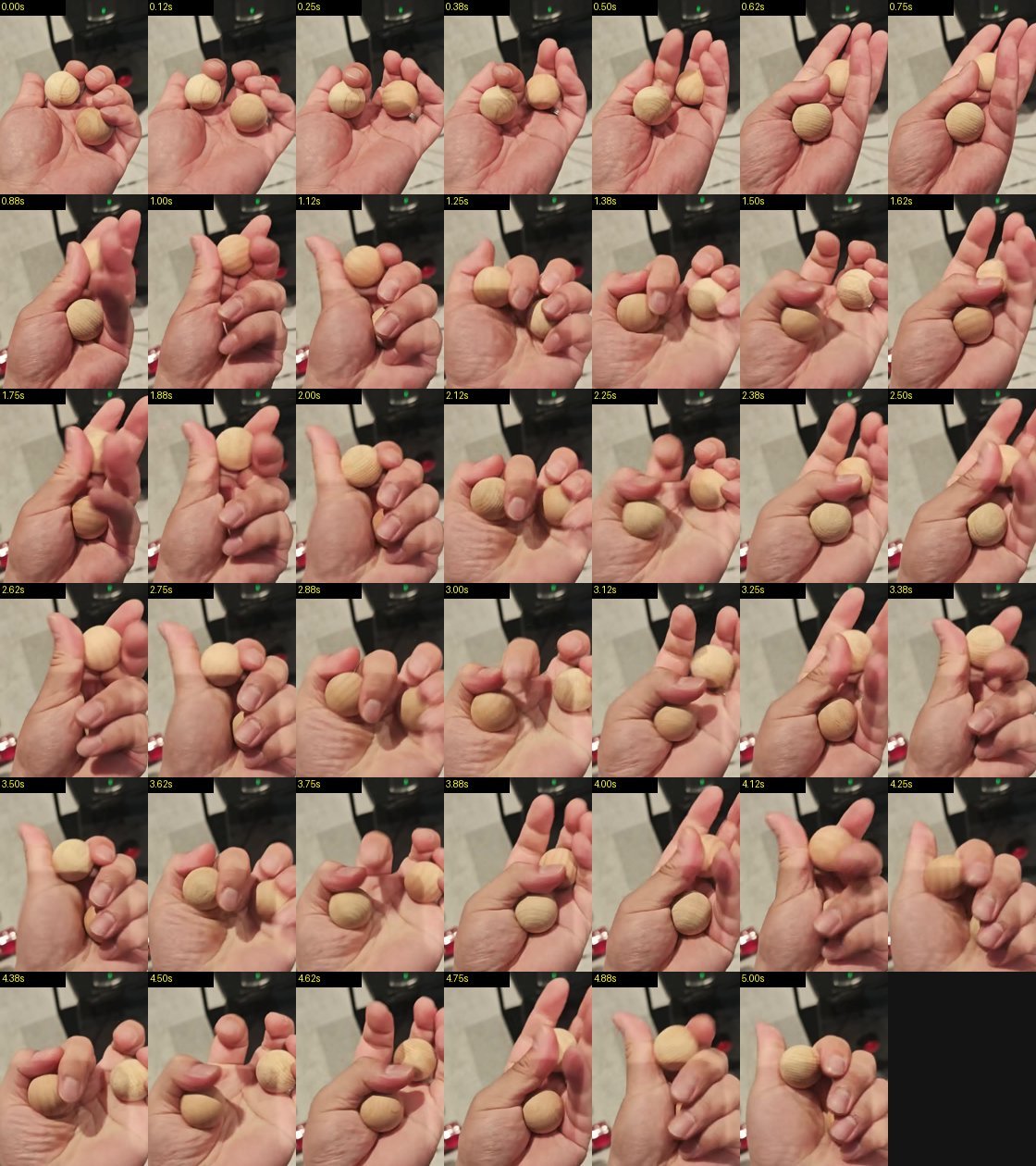
Our reference motion: my own hand, the two 30 mm wooden balls, five seconds. Every geometric number below was measured from this clip and these two balls.
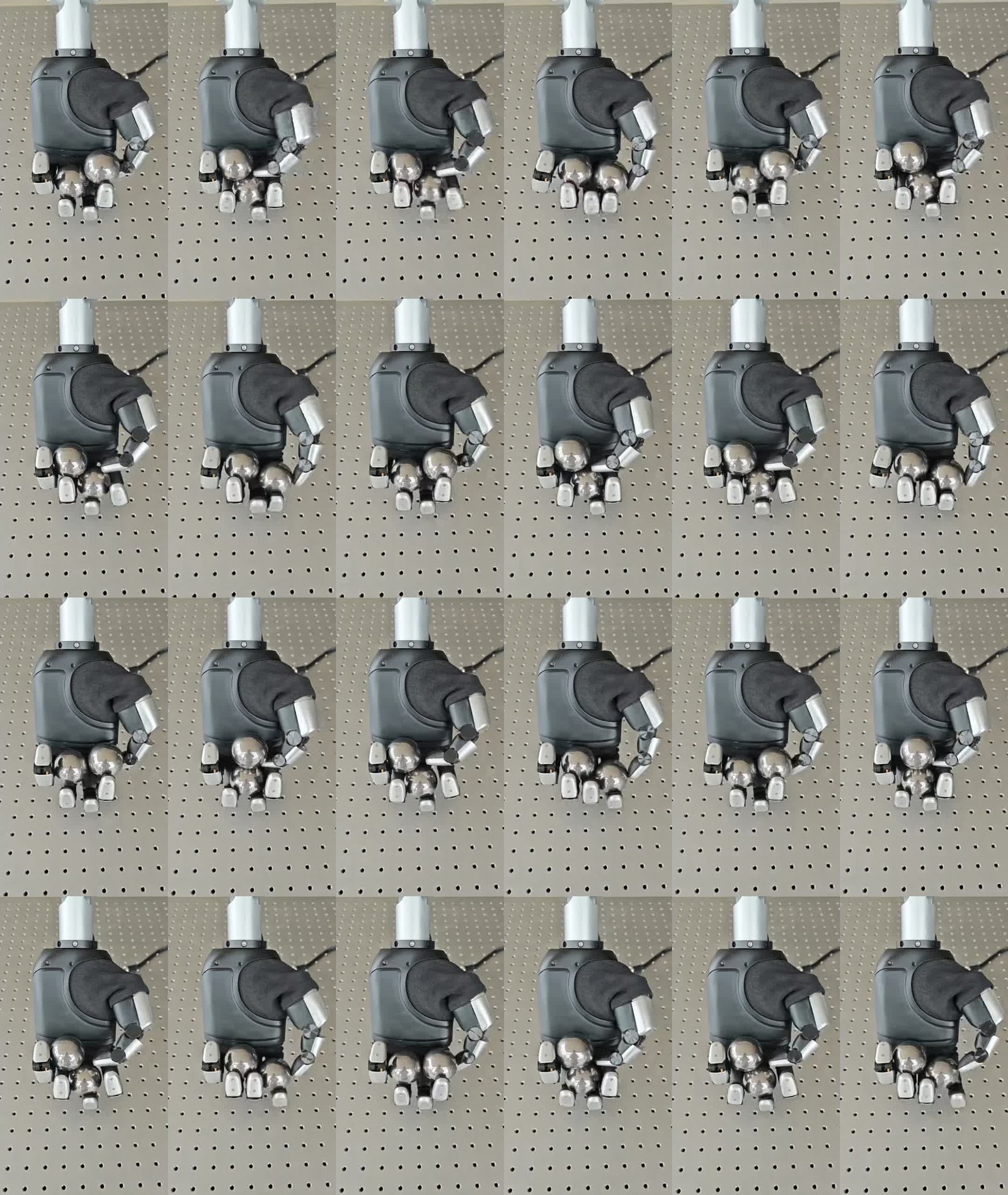
The organisers also handed us an official Apex demo — a left hand on an optical table, two mirror-finish steel baoding balls, rotating under a top-down camera. That is the motion we were aiming at; our wooden pair and hanging-hook mount are the cheap stand-in we could actually train against.
Official Rysen Apex reference: steel baoding balls circling in the palm (organiser-provided clip).
0. Define the Task First
- Objects: two turned wooden balls, 30 mm diameter, 9.55 g each as weighed → density 676 kg/m³, right in the beech / birch range. In simulation the ball radius, target gap and reset positions are all derived from that one radius; changing balls changes one number.
- Hand: left — the physical hand is a left hand, and training the left directly removes the mirror-the-policy step at deployment.
- Motion: the two balls circle each other about the palm normal. One "revolution" = each ball back where it started = the pair axis turning 2π. The metric is revolutions per episode (
baoding_revolutions), not the reward value. - Episode: 10 s (600 steps at 60 Hz); ends immediately when a ball leaves the cup.
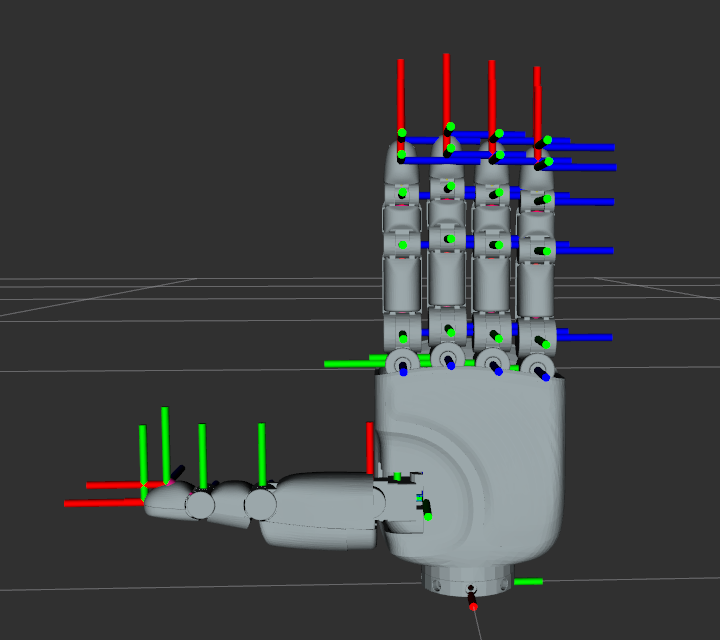
Gym ids: PAN-BaodingRotate-Apex-Left-v0 (train) / PAN-BaodingRotate-Apex-Left-Play-v0 (playback: 16 envs, noise off, no timeout). Config in source/pan_dexterous_lab/tasks/coin_roll/baoding_env_cfg.py.
1. Observations: Only What the Real Hand Can Measure
The coin policy in part ① saw privileged state (coin pose, absolute fingertip positions). On hardware none of that is measurable; it had to be fed zeros and the policy saturated. The baoding task splits actor and critic from day one:
Those six pair numbers are the contract of the whole sim-to-real chain: real/ball_tracker.py must be able to compute the same six numbers, same order, same units from two blobs plus a one-time palm calibration (part ⑤). Two things are therefore deliberately absent:
- Ball identity. The two balls are identical; a camera cannot tell which is which. If the observation carried "ball 1 / ball 2", the policy would learn from information that does not exist on hardware. The fix is to report only the pair's midpoint, gap and doubled axis angle: swapping the balls adds π to the axis angle and 2π to the doubled angle — no change.
- Height above the palm. One fixed camera cannot measure it; a 30 mm ball 30 cm away changes apparent radius by well under a pixel over a few millimetres of travel.
gravity_in_palm was added on September 8: the unit gravity vector in the hand frame — (0, 0, −1) for a level palm-up hand, (1, 0, 0) with the fingers hanging straight down at 90°. It tells the policy how the hand is mounted; on hardware the runner feeds the same constant from --mount-pitch-deg. Adding it took the observation from 55 to 58 dims, so older baoding checkpoints can no longer be --resumed.
2. Actions and Rewards
Actions are bounded deltas about the "cradle" pose (_CRADLE_JOINT_POS), scaled from the reference footage rather than from the joint ranges:
| Joints | scale (rad) | Why |
|---|---|---|
thumb j0–j3 | 0.32 | thumb-tip Jacobian ≈ 85–105 mm/rad; 0.25 only fenced and never pushed a swap, 0.5 became a hammer, 0.32 ≈ one 28–33 mm stroke from the footage |
finger j0 (abduction) | 0.25 | |
finger j1 / j2 | 0.35 | the fingers dip / lift about 15–20 mm in the footage |
Target rate is slewed at JOINT_MAX_SPEED_RAD_S = 2.0 rad/s, matching the real SDK's MaxJointSpeed, so the policy cannot learn strokes the real hand will not perform.
Current rewards (BaodingRewardsCfg):
| Term | Weight | Meaning |
|---|---|---|
target_pair | +1 | RoTO-style two-slot swap: slots at ±16.5 mm in the palm plane and ±10 mm in height (one high, one low); when a ball arrives at a slot the two slots flip. Progress only — an absolute-distance tanh is exactly how a policy learns to sit still and collect |
spin | +2 | pair-axis rotation in the commanded direction (capped at 0.12 rad per step, +1 bonus per revolution); also the sole bookkeeper of baoding_revolutions |
ball_gap | −4 | centre distance away from "just touching" (2r + 3 mm): below contact is interpenetration or a crush; a 12 mm slack band above it is free |
pair_centering | −3 | pair midpoint away from the cup centre (8 mm deadzone); measured to the cup, not to the palm origin — the origin is at the wrist, and penalising distance from it rewards dragging the pair backwards |
hold_pair | 0 | the reference footage never "parks" the pair; a per-step hold bonus is exactly how the previous run learned to sit |
drop | −12 | paid once, on the step a ball leaves; not per remaining step |
finger_crossing | −20 | self-collision is off, so this is the only thing stopping fingers from passing through one another |
action_rate_l2 / joint_vel_l2 / action_l2 | −0.01 / −2.5e-5 / −1e-4 | no jitter |
Terminations: 10 s timeout, balls_dropped, ball farther than 0.45 m from the hand. Friction 0.60–0.95 (wood on rubber pads grips far better than the metal coin), mass ±8% (the balls were weighed; the uncertain quantities are friction and joint gains, not mass).
3. Nine Experiments: Why Every One Held and Never Rotated
Each run's directory carries params/env.yaml (the full config at the time), code/ (a snapshot of the source files that determined the policy) and RUN.md (command, git, how to restore). This was the rule we set for ourselves on the evening of September 5 — "record the code and the operations behind every model, or we will never find the best one or sync the changes" — and it turned out to be the single most valuable discipline of the project.
| # | run | Idea | Outcome |
|---|---|---|---|
| 1 | 09-05_16-14-27 | HOLD: hold_pair +1 per step, balls seated in the palm cup; 4096 envs × 3000 iters | Scrapped. Holds, barely rotates |
| 2 | 09-05_19-13-22_orbit_reset | inject an initial orbit_omega=3.5 on the pair at reset | Scrapped. Learned a large-radius orbit, not an in-hand swap |
| 3 | 09-05_21-43-43_pair_mill | four fingers form a symmetric deep cup and mill the pair in place | The only one that rotates: 18.2 rev / 578 steps, 93% timeouts. Large motions, division of labour unlike the footage. Kept as a real-hand candidate |
| 4 | 09-05_22-27-26_hook_walls | pinky as a wall, thumb as the other wall plus the pusher, three fingers as a hook; centering penalises lateral only | Scrapped. Early stop at 600 iters, rev≈0.02 |
| 5 | 09-06_00-33-14_swap_targets | RoTO two-point swap (radius 16.5 mm) plus light spin; pinky tucked into the cage | Half-way: 400 iters, 5.6 rev / 600 steps, rotates; but the thumb hammers vertically with far too much travel |
| 6 | 09-06_07-57-50_thumb_wall | same reward; FK-solved rest pose with the thumb pad on the ball; thumb scale 0.25; clip_actions=1 + 2 rad/s slew | Scrapped. Plateau at 600 iters, rev≈0. target_pair's absolute-distance term was still paying for sitting |
| 7–9 | 09-06_08-43 / 09-32 / 09-43 / 09-51_over_under | slots get a ±10 mm height split (one high, one low); 12 mm gap slack; 8 mm centering deadzone; spin weight 2; progress shaping | Scrapped. Three interrupted resumes to it=600 plateau, rev≈0.006, episode≈560: sitting no longer pays, and it still does not learn the swap |
Four playbacks tell it better than the table (all from the same camera):
#1 HOLD, model_2999: rock-steady hold, no rotation. The reward curve looks beautiful — which is precisely the problem.
#2 orbit_reset: the balls do rotate — around a circle the size of the whole palm.
#3 pair_mill: 18.2 revolutions per episode. It rotates, but with very large finger motions and an almost idle thumb — not how a human divides the work.
#5 swap_targets: the thumb stands up and hammers the ball. Too much travel, but the right direction.
#7–9 over_under: slots one high, one low, no more reward for sitting — and it still chooses to hold.
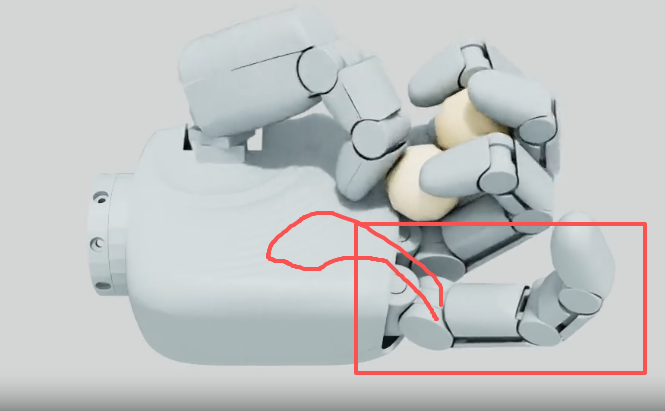
A note I wrote at 22:13 on September 5 became the design basis for runs 4–9: "the pinky is a wall, the thumb flicks the balls and is the other wall at the same time, and the remaining fingers are a hook / bowl that keeps the balls in the hollow."
3.1 What the failures have in common
- Pay per step for "holding" and the policy will only hold. We paid that tuition twice, in #1 and #6.
- An absolute-distance reward can be farmed by sitting: park the pair somewhere between the two slots and the tanh distance to both is fine, so do nothing. Only rewarding progress (the decrease in distance) closes it.
- The thumb's travel is the hardest single number: 0.25 rad cannot push a swap, 0.5 rad is a hammer, and at 0.32 rad it "dares not move".
- Every one of these experiments shared one premise — palm up, level, balls lying on the flat palm, fingers reaching down from above. Section 5 overturns it.
4. How to Read the Five Curves
The plots come from the long run #1 (4096 envs, cut at iteration 1450). It is the textbook "holds but does not rotate" case, which makes it the best material for learning to read TensorBoard.
source env.sh
tensorboard --logdir logs/rsl_rl/pan_baoding_rotate/2026-09-05_16-14-27 --port 6006
1. Total reward and survival
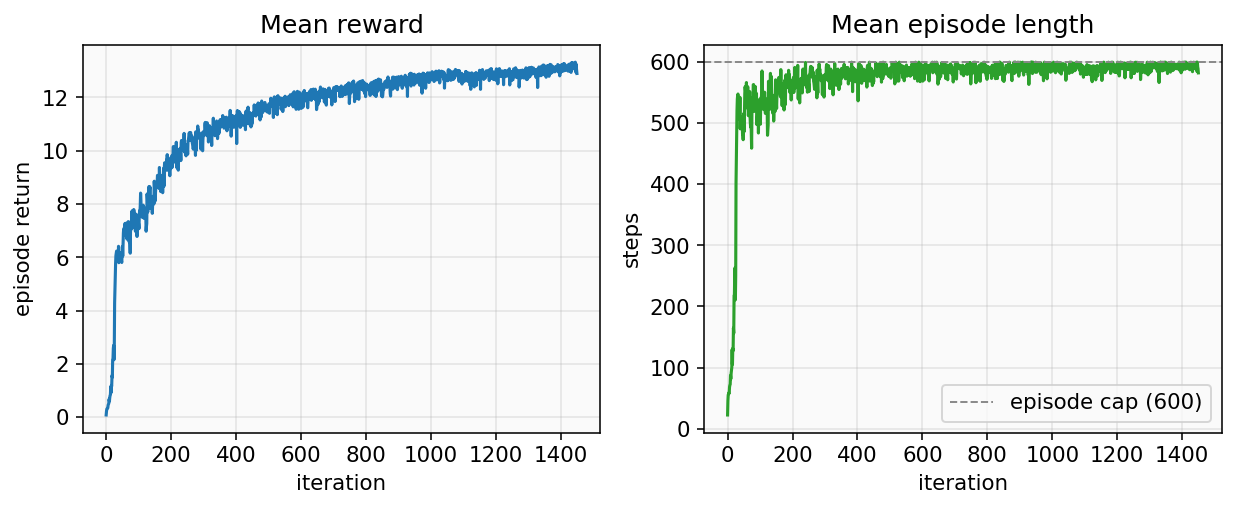
Both climb steeply over the first 100 iterations: the hand goes from "the ball flies the moment it is placed" to keeping the pair in the palm. After 100 the length hugs the 600-step ceiling while reward keeps creeping. Length at the ceiling only says nothing dropped; it says nothing about rotation.
2. Why episodes end
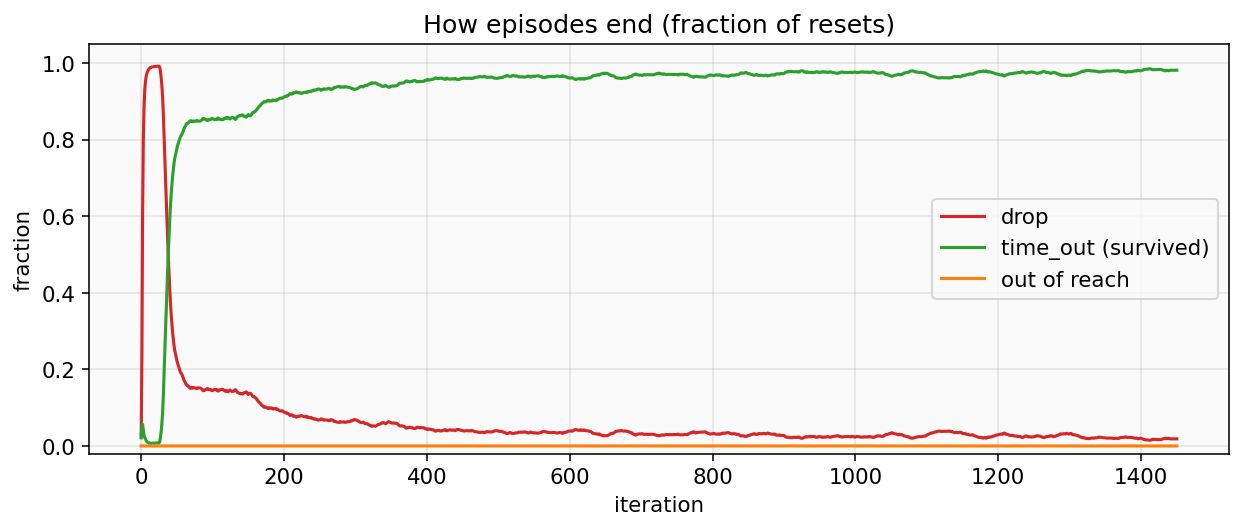
The three sum to about 1. drop falls from near 1.0 at the start (the policy flailing and flinging the balls) to about 2%, time_out rises to about 98%. Red down, green up = it learned to survive first.
3. The task itself
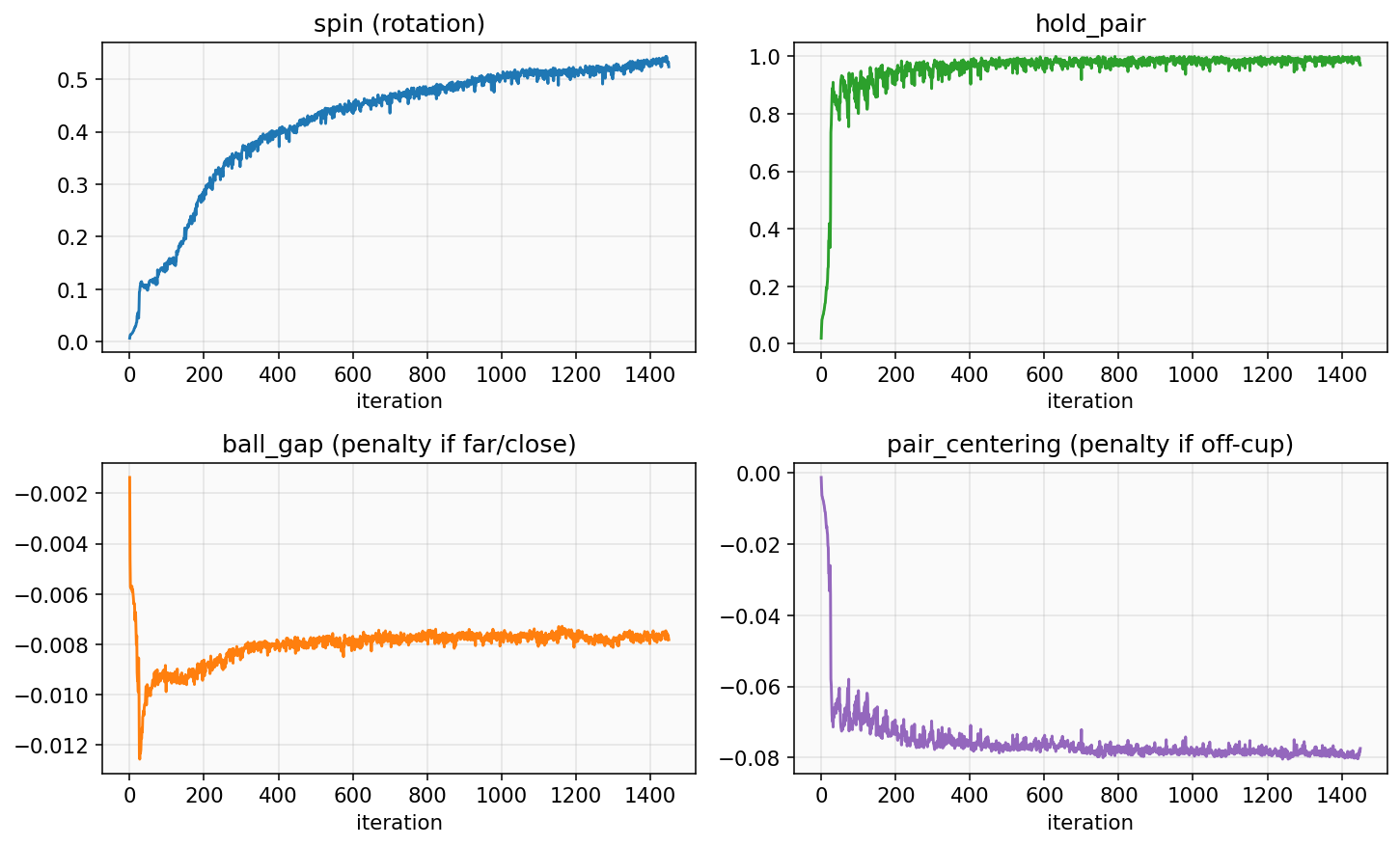
hold_pair quickly reaches 0.97 and saturates; spin creeps around 0.52. Once hold is saturated, spin is the only curve worth watching — a long plateau with a flat total reward is the signal to stop or change the reward. Here we knew before the plateau: in playback the balls simply did not move.
4. Motion regularisers
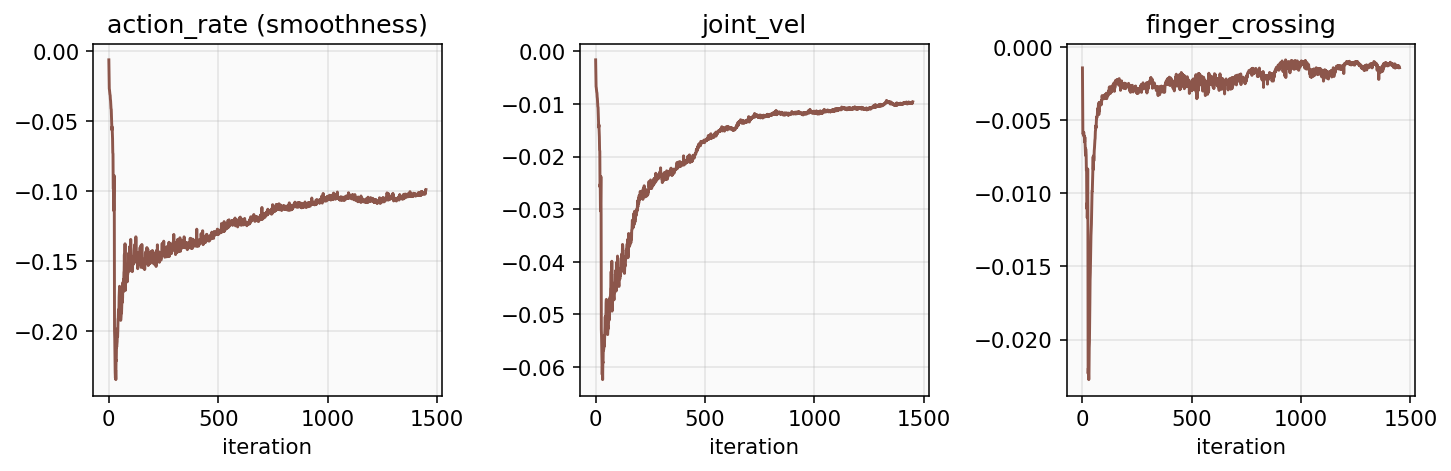
All small negatives. finger_crossing has weight −20 and still hugs 0 (about −0.001), so there is almost no crossing; if it dropped below −1 the fingers would fight on the real hand.
5. PPO internals
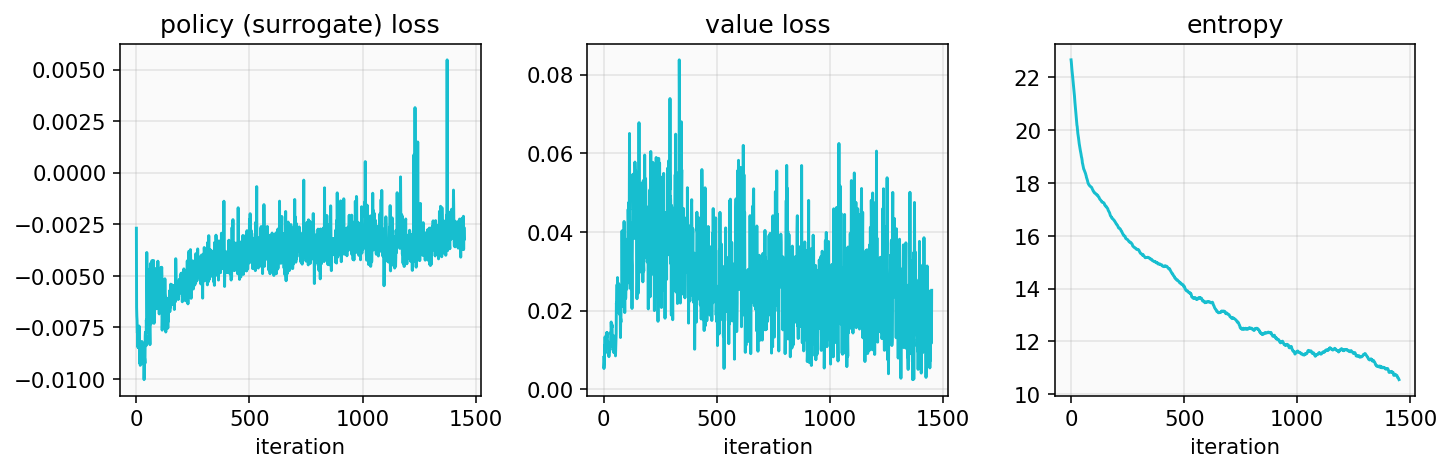
A wobbly surrogate is normal; value loss just must not diverge (the critic sees privileged ground truth, so it only reflects how stable the estimate is); entropy is still at 10.5 and has not collapsed. Do not use these three to judge whether the balls rotate.
Throughput: about 37–43k steps/s at 4096 envs, 3000 iterations in about 1 h 50 min; on 12 GB that is this machine's practical ceiling.
5. The September 8 Realisation: the Hand Was Mounted the Wrong Way
At 1:22 AM, re-watching the reference footage, it clicked: the hand in the video is not held level. It hangs, fingertips below the wrist, the two balls seated in the hook formed by the curled index / middle / ring fingers, with the pinky and thumb as side walls and the thumb pushing the ball from below upward to swap. All nine of our experiments were palm-up, level, fingers reaching down from above — a different task.
Which geometry is learnable is not something to guess. The approach is to run several mount angles in one training:
events.hand_tilt(a startup event) rotates envi's hand about its palm cup bypitch_deg[i % buckets], fixed for the whole run — equivalent to bolting the hand to the bench at that angle. Rotating about the cup keeps the ball spawn points and the playback camera unchanged.- Every geometric term (ball seats, RoTO slots, the drop test, centering, the
pairobservation) was moved into the hand frameHandFrame(_geom.hand_frame: forward / lateral / palm-normal axes derived from the root pose) instead of assuming palm normal = world +Z. The 0° bucket reproduces the old numbers exactly. - The policy tells buckets apart through the new
gravity_in_palmobservation. - The training log prints one line every 50 iterations:
[tilt] pitch+0: x.xx rev / drop 0.xx pitch+30: …; in TensorBoard it isTrain/baoding_revolutions/pitch+XXandTrain/drop_rate/pitch+XX. Watch which bucket's drop falls first and whose rev rises first, then narrow the buckets around that angle (env.events.hand_tilt.params.pitch_deg=[60,75,90],jitter_deg=5turns them into a band). - Static check first: zero action, default grip, 0 / 30 / 60 / 90° — 0% drops within 3 s at every angle. The existing cradle pose hooks the balls even vertical, so any difference between buckets is learnability, not spawning-and-falling.
# formal sweep: default buckets 0/30/60/90, 512 hands per bucket
python scripts/train.py --task PAN-BaodingRotate-Apex-Left-v0 --headless --num_envs 2048 --seed 42 \
  --run_name tilt_sweep
# watch an 8×8 grid of hands while training
python scripts/train.py --task PAN-BaodingRotate-Apex-Left-v0 --viz kit --grid_view \
  --max_visible_envs 64 --num_envs 64 --max_iterations 300
# pick an angle at playback
python scripts/play.py --task PAN-BaodingRotate-Apex-Left-Play-v0 --num_envs 1 --checkpoint ... \
  env.events.hand_tilt.params.pitch_deg=[60]
5.1 Result of the first windowed sweep (recorded as is)
512 envs with the window rendering, early-stopped at 600 iterations, rev plateaued at 0.13. Drop rate per bucket:
| Mount angle | 0° | 30° | 60° | 90° |
|---|---|---|---|---|
| drop | 0.89 | 0.34 | 0.88 | 1.00 |
Only the 30° row learned to hold; nobody rotates yet. 512 envs plus window rendering is too small a run to conclude anything; the formal run is --headless --num_envs 2048 --run_name tilt_sweep, with --video --video_interval 12000 --grid_view to collect time-lapse footage on the way. The result will be folded in here.
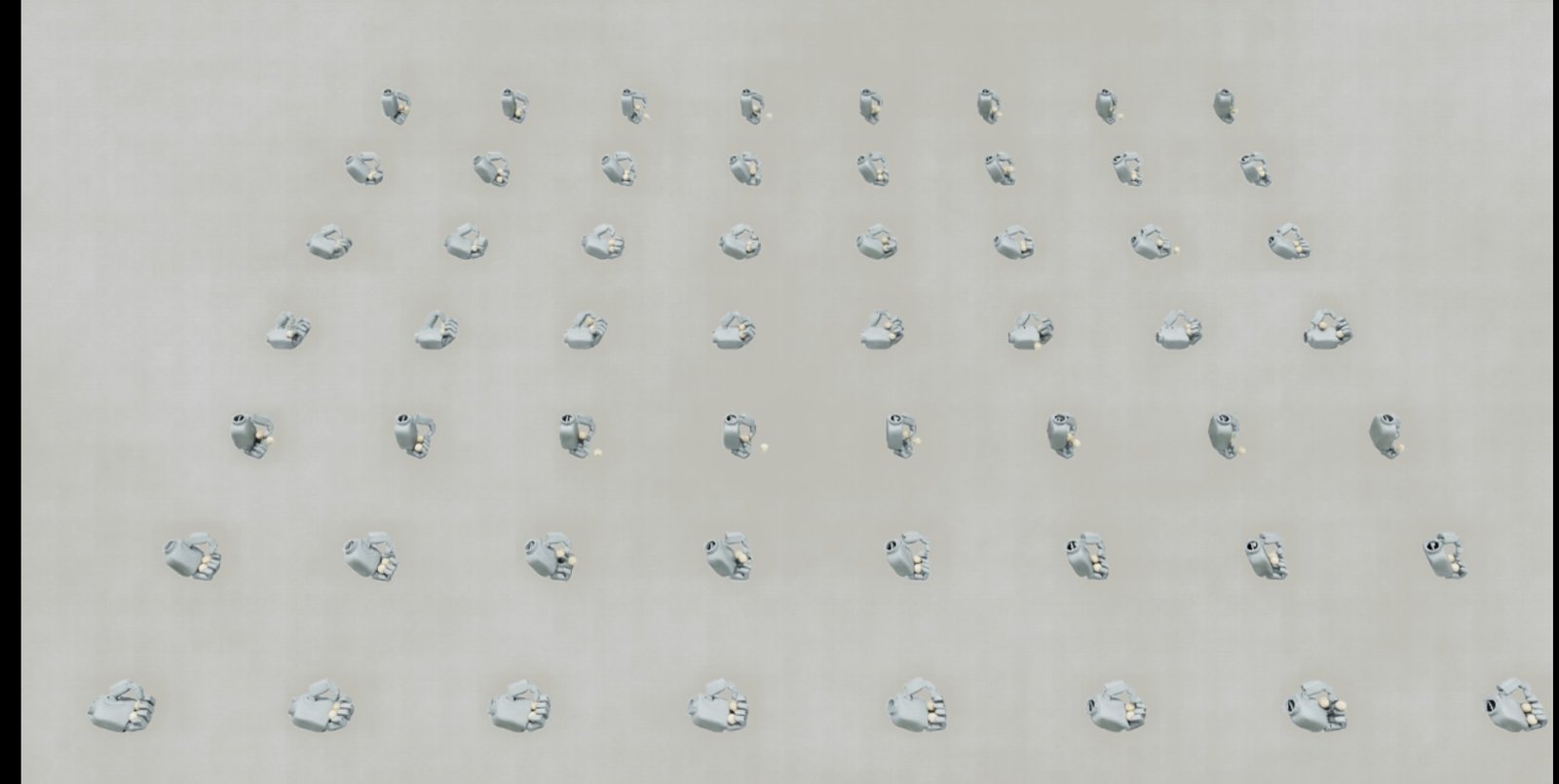
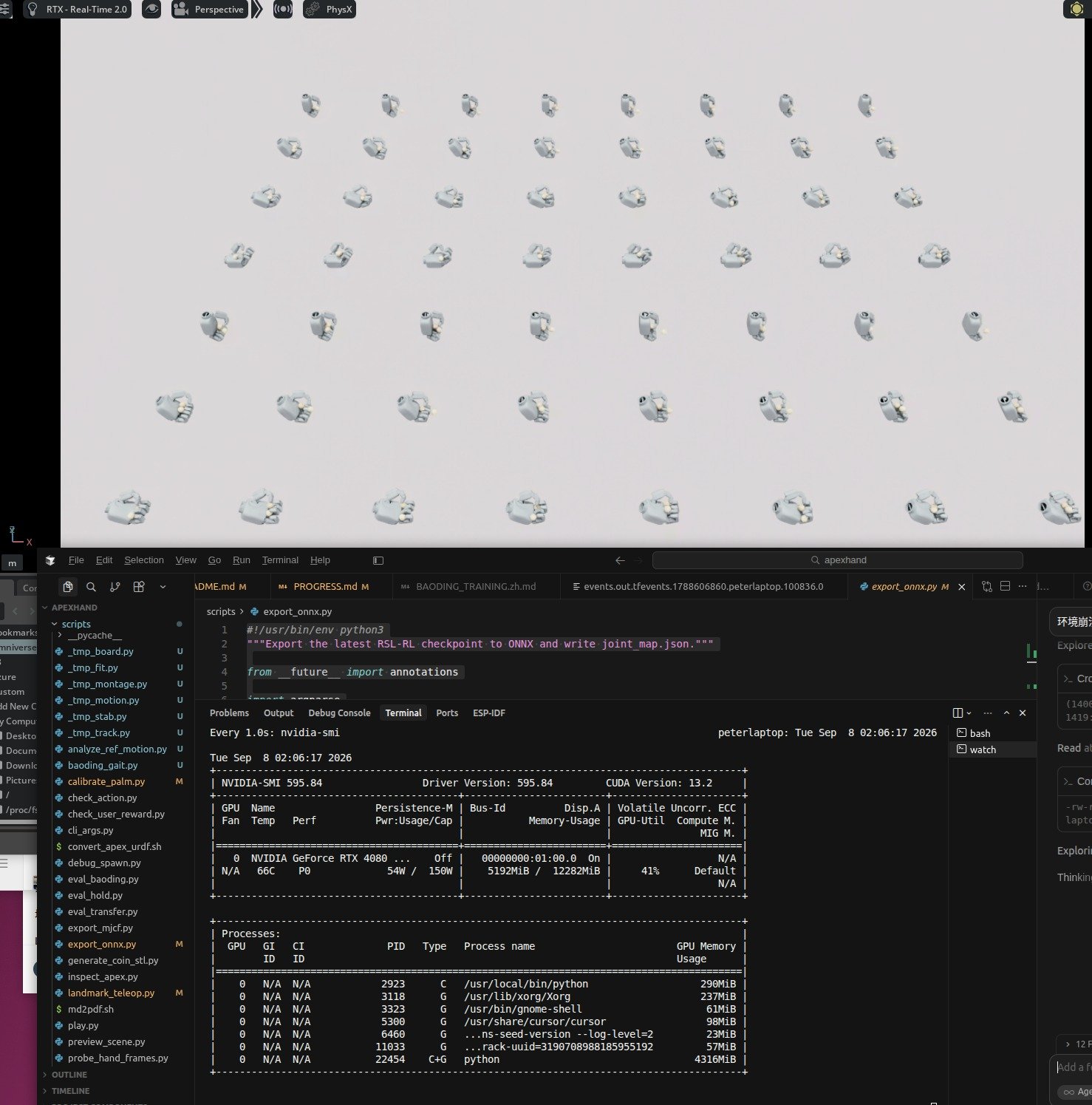
The random policy at iteration 0: 16 hands in a 4×4 grid, one mount angle per row (top to bottom 90° / 60° / 30° / 0°).
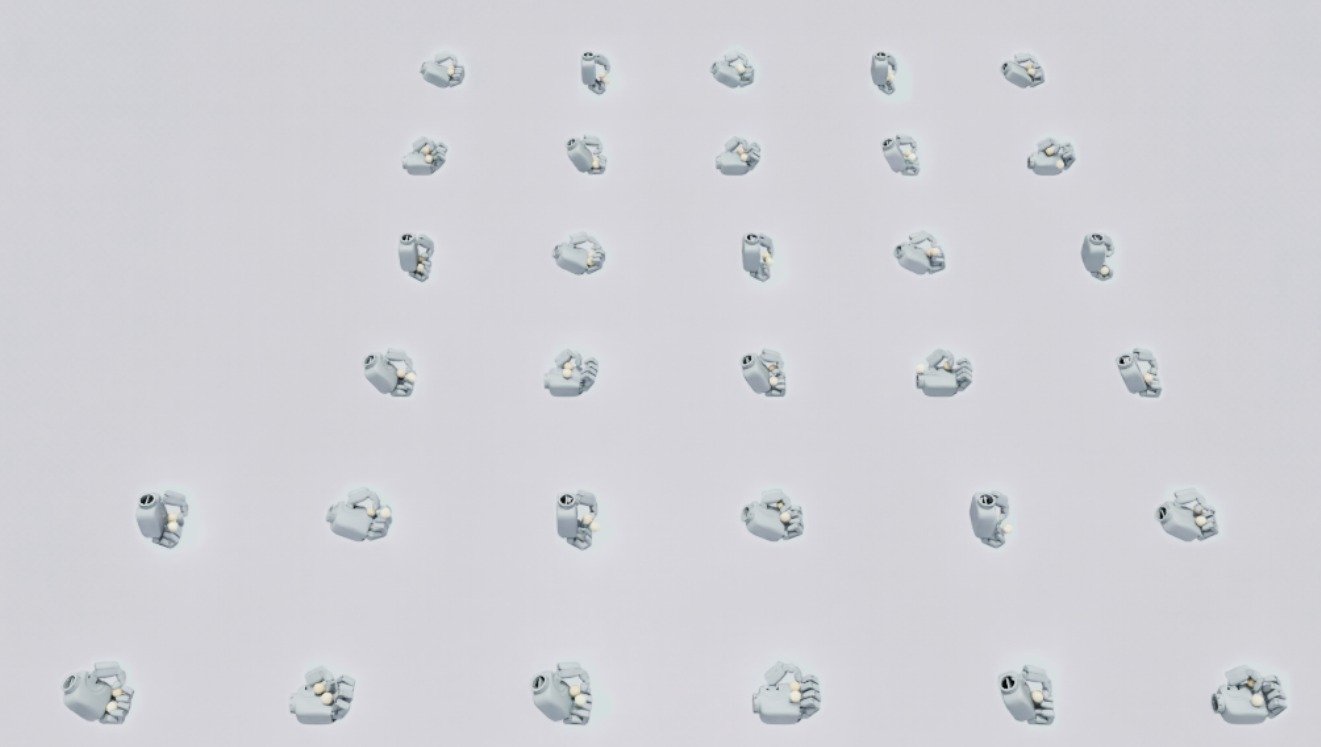
Same camera after 600 iterations: the 30° row is stable, the others still drop.
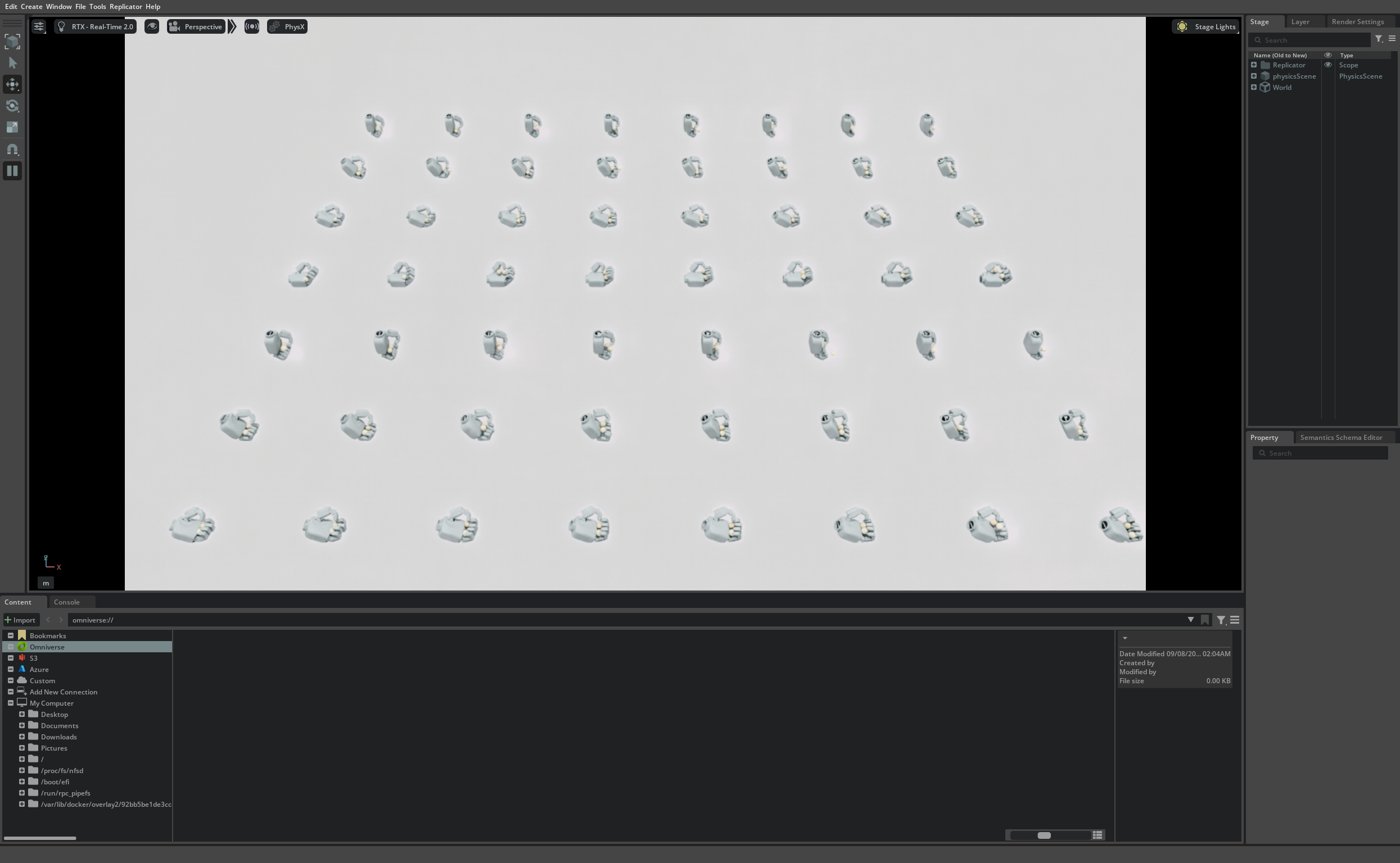
20 seconds recorded straight off the Kit window: the grid of hands mid-training.
6. Recording Training as Video
Three methods, each with its use:
1. Automatic recording during training (recommended for time-lapses) — every N environment steps, render a clip off-screen from a fixed camera; no window needed:
python scripts/train.py --task PAN-BaodingRotate-Apex-Left-v0 --headless \
  --num_envs 256 --video --video_length 300 --video_interval 2400 --grid_view
# -> <run>/videos/train/rl-video-step-{0,2400,4800,...}.mp4   one 5 s clip every 100 iterations
2. Re-record per checkpoint after training (same camera, any checkpoint / angle):
for ck in model_0 model_300 model_600; do
  python scripts/play.py --task PAN-BaodingRotate-Apex-Left-Play-v0 --headless \
    --num_envs 16 --video --video_length 600 --grid_view \
    --checkpoint logs/rsl_rl/pan_baoding_rotate/<run>/$ck.pt
done
3. Record the Kit window directly (works even when other windows cover it):
ffmpeg -f x11grab -window_id <id from xwininfo> -framerate 15 -i :1 -t 20 out.mp4
Concatenate with ffmpeg -f concat -safe 0 -i list.txt -c copy out.mp4 (list.txt has one file '/abs/path.mp4' per line). The WebUI console exposes the same three knobs — "record periodically during training / recording interval / clip length" — and plays the resulting mp4s in its "Videos" tab.
The pitfall: Isaac Lab 3.0's --video goes through VideoRecorderCfg, which copies viewer.eye / lookat as world coordinates when the env is constructed and has nothing to do with the Kit window's camera controller — they are two separate cameras. Our first version moved the window camera after building the env: the window looked right, the recording pointed at the empty floor between two hands, and the clips came out blank. The fix is for --grid_view to compute the grid extent from num_envs × env_spacing before the env is built and write it into viewer (pan_dexterous_lab/viewer.py, shared by train and play), so the window and the recorder use the same numbers.
7. Restoring Any Experiment
RUN=logs/rsl_rl/pan_baoding_rotate/<run>
cp "$RUN/code/apex_cfg.py"         source/pan_dexterous_lab/assets/apex_cfg.py
cp "$RUN/code/objects.py"          source/pan_dexterous_lab/assets/objects.py
cp "$RUN/code/baoding_env_cfg.py"  source/pan_dexterous_lab/tasks/coin_roll/baoding_env_cfg.py
cp "$RUN/code/rewards_baoding.py"  source/pan_dexterous_lab/tasks/coin_roll/mdp/rewards_baoding.py
cp "$RUN/code/events.py"           source/pan_dexterous_lab/tasks/coin_roll/mdp/events.py
cp "$RUN/code/_geom.py"            source/pan_dexterous_lab/tasks/coin_roll/mdp/_geom.py
cp "$RUN/code/rsl_rl_ppo_cfg.py"   source/pan_dexterous_lab/tasks/coin_roll/config/apex_hand/agents/rsl_rl_ppo_cfg.py
The initial pose q0 the real hand needs lives in that run's exported/joint_map.json, independent of the repository's current _CRADLE_JOINT_POS.
8. Pitfall List
- Paying per step for "holding" → it only holds.
hold_pairweight zero. - Absolute-distance tanh → farmed by sitting. Reward progress only.
- Ball identity in the observation → learning from information the hardware lacks. Doubled angle.
- Thumb travel 0.25 / 0.5 / 0.32 rad: three numbers, three ways to fail.
- A left hand is not a string replacement:
hand_side.apply_hand_side()must move the USD, the joint list and thesideinjected into every reward term together, or the left-hand USD gets asked "where isright_palm_link" with the error far from the cause. --resumeof an old checkpoint into a new observation size fails on shape — adding an observation is a new experiment.- 4096 envs is the ceiling on 12 GB; drop to 64 envs when the window is open.
- The recorder camera and the window camera are two different cameras (section 6).
9. File Map
| Module | Path |
|---|---|
| Task config | source/pan_dexterous_lab/tasks/coin_roll/baoding_env_cfg.py |
| Rewards | .../mdp/rewards_baoding.py |
Observations (pair, gravity_in_palm) | .../mdp/observations.py |
| Hand frame and geometry | .../mdp/_geom.py |
Events (hand_tilt, resets) | .../mdp/events.py |
| Left/right conversion | .../hand_side.py |
| Object presets | source/pan_dexterous_lab/assets/objects.py |
| Recording camera | source/pan_dexterous_lab/viewer.py |
| Evaluation | scripts/eval_baoding.py (revolutions per episode plus drop / fly-out / crossing cheat counts) |
| Experiment index | docs/BAODING_RUNS.md, docs/BAODING_TRAINING.zh.md |
Next: ⑤ Baoding sim-to-real and lessons — everything the real-hand side has to do once the policy is exported.