⑤ Baoding Sim-to-Real: the Observation Contract, Palm Calibration, Ball Tracking, a Phase Gait
Part 5 of the series · Previous ④ · Overview
Part ④ ended at export_onnx.py. This part is everything the real-hand side has to do — and the infrastructure most worth writing down from these two days, because all of it serves one goal: turn a mismatch into a startup error instead of an inexplicable failed experiment. The end of the article states the status honestly: no-load playback works, the real hand holds the balls, the closed loop with balls is not yet stable.
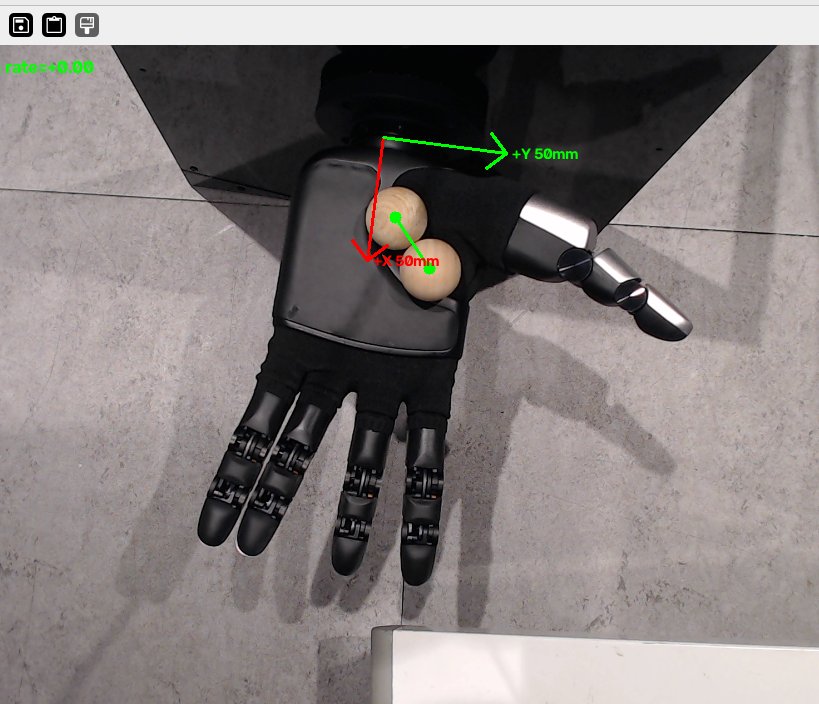
0. What the Real-Hand Loop Looks Like
source env_real.sh
python scripts/calibrate_palm.py --camera 2 --side left --out configs/palm_calib.json
python -m real.policy_runner --onnx logs/rsl_rl/pan_baoding_rotate/<run>/exported/policy.onnx \
  --camera 2 --calib configs/palm_calib.json --spin +1 --gain 0.3 --show
1. The Incident: Silent Observation Misalignment
The first time the coin policy went onto the real hand, the observation vector was an 88-element layout hand-written in the hardware script, padded at the end with a literal np.zeros(15). Later the policy changed shape. Nothing raised an error. The vector shifted as a whole, and the hand just twitched slightly. This class of bug never crashes; it only makes you believe "the sim-to-real gap is too big" and tune in the wrong direction — which we genuinely did for a while.
The fix was to make the observation layout an artefact exported by the training side:
scripts/export_onnx.pywrites the actor's observation layout intojoint_map.jsonterm by term: each term's name and dimension, the actuated joint order, the action scale (regex → joint), EMA α, control rate, hand side, and the mount-angle bucketshand_tiltused in training.real/obs_assembler.pyfills each term from a named provider according to that spec; any term without a provider fails at startup. It does not know the total dimension itself — everything comes from the spec.
joint_map.json (excerpt)
  task, checkpoint, side
  actuated_joint_names[16]   # policy dim i ≡ this entry; never reorder after the fact
  coupled -> source
  action_scale (regex -> rad), ema_alpha, control_hz
  obs_terms: [{name: joint_pos, dim: 16}, {name: joint_vel, dim: 16},
              {name: pair, dim: 6}, {name: spin_command, dim: 1},
              {name: gravity_in_palm, dim: 3}, {name: last_action, dim: 16}]
  hand_tilt: {pitch_deg: [0, 30, 60, 90]}
When policy_runner receives a policy that asks for pair but no --calib was given, it refuses to arm. An observation mismatch is now a startup error.
A related lesson: a left hand is not a string replacement. The original left-hand conversion replaced right_ with left_ in joint names, but the reward / observation terms also resolve body names (palm, knuckles, pads, tips) through a side parameter that defaulted to "right", so the left-hand USD got asked "where is right_palm_link", with the error far from the cause. Now hand_side.apply_hand_side() moves the USD, the joint list and the side injected into every term together, and the exporter records the side in joint_map.json.
2. Palm Calibration: Click Four Finger Roots
The policy's pair observation is metres in the palm frame, so the camera has to know where the palm frame sits in the image. The hand and the camera are both fixed, so a one-time similarity-transform calibration is enough.
python scripts/calibrate_palm.py --camera 2 --side left --out configs/palm_calib.json
# add --realsense to also store the palm depth palm_depth_m
Flow: Space freezes a frame → click the index, middle, ring, pinky metacarpal heads (MCPs) in order → Enter solves, Backspace undoes. Those four points' palm-frame positions were measured off the articulated model in simulation (ball_tracker._LEFT_MCP_LANDMARKS_M, read in the cradle pose with debug_spawn.py): on a palm-up hand they are the most recognisable points in the image, and abduction barely moves them, so they hold for any cradle-like pose. Two clicks are enough mathematically; four let the residuals catch a mis-click. On synthetic data the regression residual is under 0.01 mm.
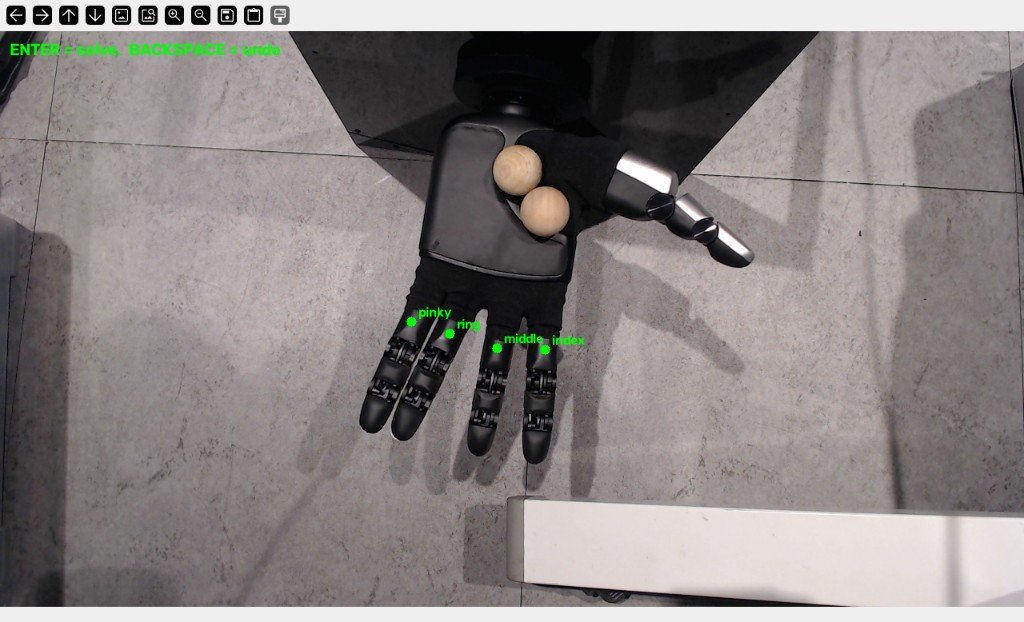
The hand must be in the cradle pose during calibration — policy_runner --warmup holds exactly that pose, so run the two side by side.
3. Ball Tracking: Produce Exactly the Simulator's Six Numbers
real/ball_tracker.py has one job: produce the six numbers that part ④'s baoding_pair_obs defines, same order, same units:
| Index | Meaning |
|---|---|
| 0:2 | pair midpoint relative to the cup centre, in the palm plane (metres) |
| 2:4 | cos / sin of the doubled axis angle |
| 4 | centre-to-centre gap |
| 5 | doubled-angle rate (rad/s) |
Two facts drive the design:
- The balls are indistinguishable → no identity in the six features (doubled angle). Only the gait clock (section 5) keeps a nearest-neighbour identity so the "thumb-side seat" stays the thumb-side seat across a swap.
- Hand and camera are both fixed → one calibration maps pixels to palm-frame metres. Height is optional: with a D435, aligned depth plus the
palm_depth_mfrom calibration gives the ball surface height; without it, the six features are unchanged.
Detection is "a bright-enough blob hunt plus a palm-frame gate": the wood is saturated brown, not pale, so saturation is left open; a box 10 cm around the cup and 8 cm deep (the same envelope as the simulator's drop test DROP_RADIUS_M / DROP_DEPTH_M) is what drops the grey floor tiles.
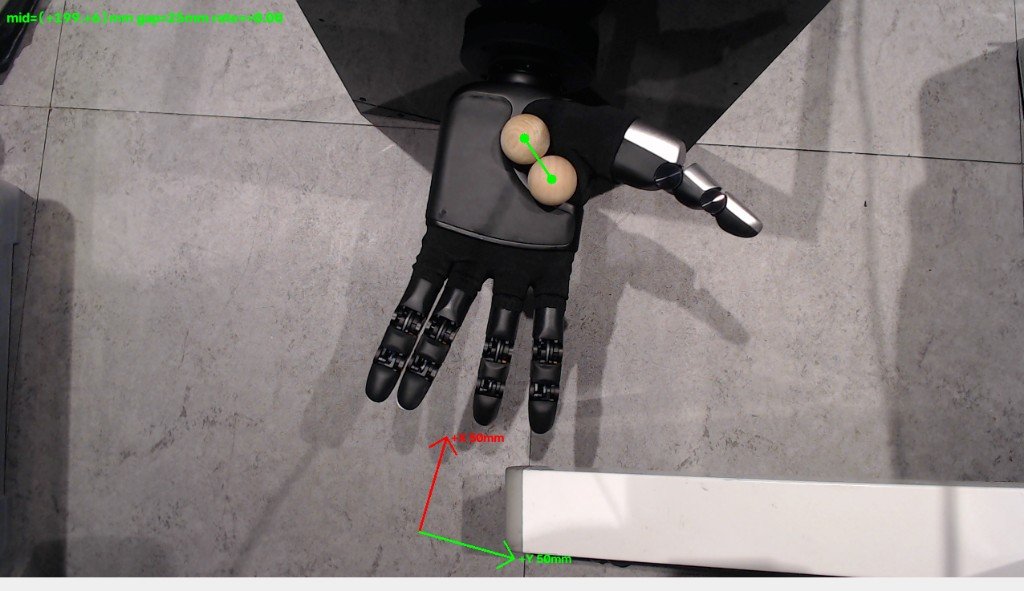
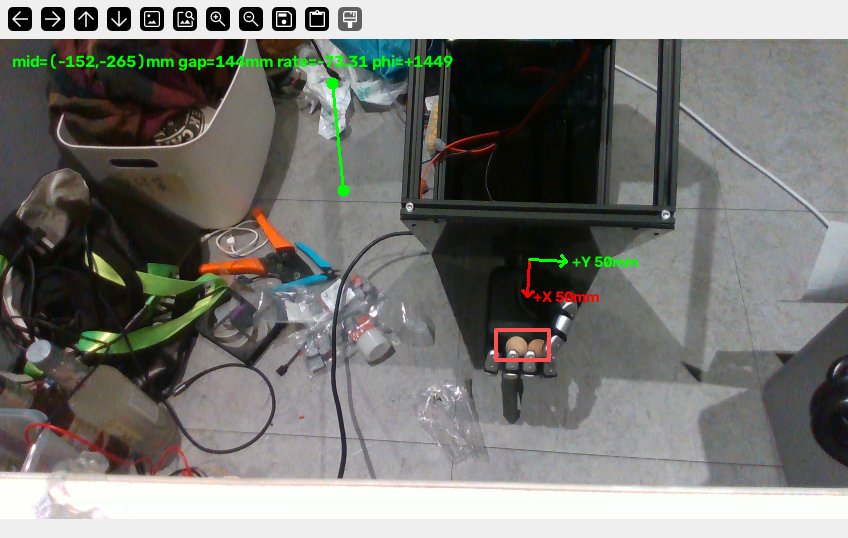
python scripts/calibrate_palm.py --camera 2 --side left --out configs/palm_calib.json --preview
# no clicking: load the calibration and show the live pair features
4. Policy Playback: real/policy_runner.py
# no load: verify the mapping and limits only, clear the surroundings
python -m real.policy_runner --gain 0.30 --seconds 12

# closed loop with balls (calibrated, camera at --camera 2)
python -m real.policy_runner --onnx <run>/exported/policy.onnx \
  --camera 2 --calib configs/palm_calib.json --spin +1 --gain 0.3 --show \
  --mount-pitch-deg 0
Every tick: read 16 joint positions / velocities from the SDK → BallTracker.observe() → ObsAssembler builds the observation → ONNX inference → clip the output to ±1 → multiply by the action_scale from joint_map (regexes matched against the real left_* joint names, last match wins, as in Isaac Lab) → add the initial pose q0 → SafetyFilter → send. 60 Hz, matching the simulator's decimation=4 @ 240 Hz.
A few parameters:
| Parameter | Effect |
|---|---|
--gain | action gain; start at 0.3 and open up gradually |
--mount-pitch-deg | the hand's mount pitch on the bench, giving gravity_in_palm the same constant; warns if outside the trained buckets |
--warmup | seconds to hold the cradle pose before arming, for placing balls / calibrating |
--realsense | D435 through the same tracking.camera.open_source path |
Policy playback uses SafetyFilter(hold_on_lag=True): a joint lagging its target by 0.18 rad (about 10°) is treated as having hit something and that finger freezes — right for a policy, wrong for teleoperation (part ③).
5. The Non-RL Fallback: a Phase-Indexed Gait
A hackathon needs a demo, and RL does not necessarily converge on schedule. On the morning of September 6 we built a parallel route that trains no policy at all: real/gait.py plus scripts/baoding_gait.py.
The core idea: the gait table q_ref(φ) is indexed not by time but by the phase φ of the pair axis — the angle the BallTracker reports. One revolution = φ advancing 2π. The two balls are identical, so after one swap (φ advancing π) the hand is back in the same physical situation; the table therefore repeats every π (ORBIT_FOLD = 2), the fit sees both swaps as one, and A/B labels become irrelevant.
Three sources, one fit / playback path:
# 1) geometric seed: no camera, hand only
python scripts/baoding_gait.py synthesize --out logs/gait/orbit_q_ref.npz
python scripts/baoding_gait.py play logs/gait/orbit_q_ref.npz --open-loop --seconds 8

# 2) human demonstration: record landmarks + q + φ + current during teleoperation
python scripts/landmark_teleop.py --realsense --calib configs/palm_calib.json \
    --record logs/gait/demo.npz --side left
python scripts/baoding_gait.py fit logs/gait/demo.npz --out logs/gait/q_ref.npz
python scripts/baoding_gait.py play logs/gait/q_ref.npz --calib configs/palm_calib.json --realsense

# 3) self-learning: the camera watches the cup, each episode is scored on how far the pair actually turned,
#    and the table is refit from the poses commanded at each ball phase
python scripts/baoding_gait.py learn --calib configs/palm_calib.json --realsense --iters 20 --episode-s 12
The seed amplitudes are not guesses; they come from part ③'s FK: in the cradle pose, 8° of finger PIP ≈ 9 mm of fingertip travel along the palm normal, 6° of abduction ≈ 10 mm sideways, 16° of thumb j0 ≈ 12 mm across the palm and 6° of j2 another 6 mm — one thumb stroke of about 35 mm, the footage's, not the 55 mm hammer. One revolution takes 2.0 s, a little slower than the footage's 1.3–1.8 s, to keep the thumb sweep under JOINT_MAX_SPEED_RAD_S.
Playback is closed-loop: look up the base pose from the table, then add a small residual from the live pair / height / current.
5.1 Do not crush the balls
A field note from 11:34 on September 6: "watch the current feedback or we will crush the balls." A position target that lands inside a ball stalls the motor at the torque cap and stays there; the ball gets pinned, and the camera loses it too (12:08: "the initial pose clamps the balls so hard they are not detected").
Two fixes:
- Current relief (part ②) applies to everyone: above a finger's contact threshold, its flex joints open in proportion and close again as current drops.
- A re-seat pose
_OPEN_OFF: open the cradle further (indexj1−15°,j2−25°, …) so the fingertips clear a 30 mm ball and the palm hollow is exposed; balls dropped in from above roll into the cup instead of landing on the finger arch, and the camera sees both whole disks.
September 6, 11:30: the hand hung from the chassis fingertips-down, balls seated in the hook of three curled fingers, the tracker window on the laptop. Two days later we realised this is the geometry the reference footage actually shows.
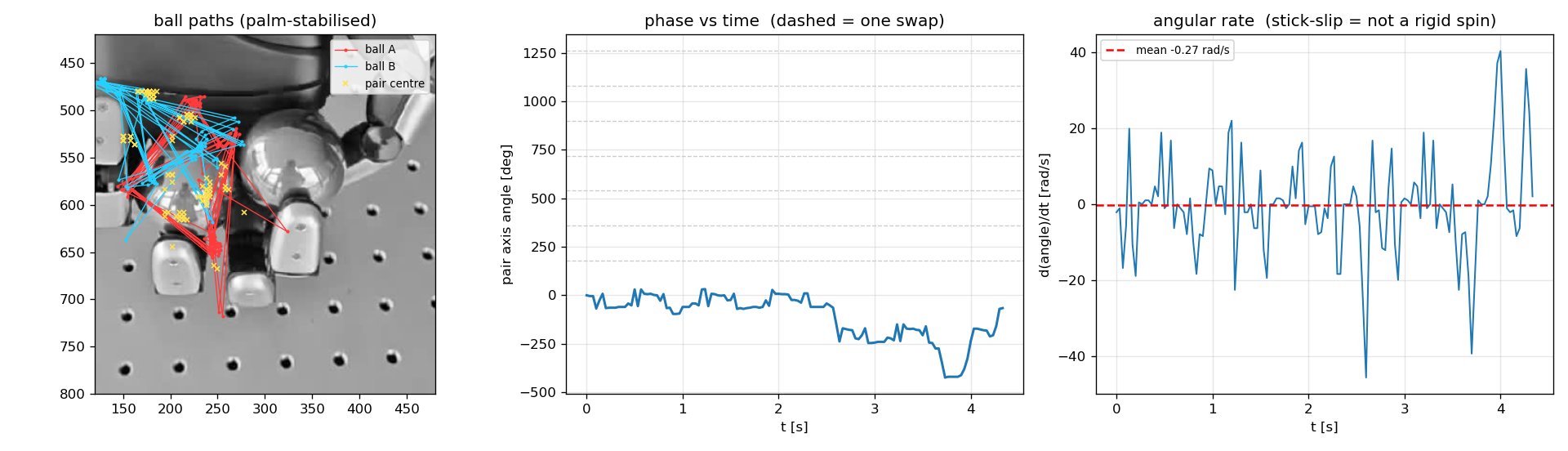
The same geometry shows up when we track the official steel-ball clip with scripts/analyze_ref_motion.py: the pair axis advances, but the angular rate is stick-slip rather than a rigid spin — useful as a kinematic target for the gait table, not as a claim that our wooden-ball policy already matches it.
6. Status (Honest)
| Item | Status |
|---|---|
| Network, SDK, read-only smoke test | done |
| Webcam teleoperation driving the real hand | done, 19 minutes continuous; Kapandji 9 |
| ONNX no-load playback | done, 60 Hz, safety layer in the loop |
Observation contract joint_map.json + ObsAssembler | done |
| Palm calibration + ball tracking | done, configs/palm_calib.json |
| Real hand holding two balls | done (booth video) |
| Closed loop with balls rotating on the real hand | not stable. The simulated policy itself still "holds but does not rotate" (part ④); the phase gait moves but has no stable full revolution yet |
| Mount-angle sweep | in progress |
The risk and fallback were already written into Checkpoint 1: if the closed loop with balls is not stable, demonstrate in-hand capability with the teleoperation that already works and report the simulated revolution metric — two independent chains that cannot fail together. That is exactly what happened at the booth.
7. Lessons of the Two Days
- Silent observation misalignment is the most dangerous bug. Make the layout an artefact exported by training; fail at startup on a missing term.
- A left hand is not a string replacement. Move the USD, the joint list and the
sideparameter together. - Two firmware pitfalls:
deg2rad(100)exceeds the firmware cap of 1.7453 rad; current gets stuck at a 449–453 mA fake rail. - Over-current protection and a deliberate pinch cannot be distinguished by current. The layer above feeds intent forward to the safety layer.
- Self-collision must be off, so finger crossing needs its own guard. Abduction clamp 0.04 +
finger_crossing−20. - The two balls are identical. No identity in the observation; use the doubled angle.
- Monocular cannot measure depth. Ball height above the palm is the biggest uncertainty in the baoding task on hardware; a second viewpoint or a tactile array later.
- Rewards get hacked, differently every time: spinning the coin in place, sitting with the balls, farming absolute distance. Reward progress only, and always watch the playback.
- 12 GB of VRAM: 2048 envs take about 4.5 GB, 4096 is the ceiling for the baoding task; never run two trainings.
- Pay per step for "holding" and the policy only holds. The reference motion never contains a "parked" state.
8. Next Steps
- Run the mount-angle sweep properly (2048 envs, headless) and narrow the buckets to the angle band where drop falls first;
- Widen domain randomisation on joint gains and friction; the URDF dynamics were never identified, so a policy cannot be assumed to transfer directly;
- A second viewpoint (or the D435's depth) for ball height, or the tactile array;
- Switch between the phase gait and the RL policy inside the same
policy_runner, and run whichever is stable at the booth.
9. File Map
| File | Responsibility |
|---|---|
scripts/export_onnx.py | ONNX + joint_map.json (observation layout, mount-angle buckets) |
real/obs_assembler.py | rebuilds the observation from the spec; fails on a missing term |
real/policy_runner.py | 60 Hz playback loop |
scripts/calibrate_palm.py | similarity-transform calibration by clicking four MCPs |
real/ball_tracker.py | 6-dim pair features, palm-frame gate, gait clock |
real/gait.py, scripts/baoding_gait.py | phase-indexed gait: synthesize / fit / play / learn |
real/safety.py | limits, Δq, current relief, lag freeze |
docs/CHECKPOINT1.zh.md | the Checkpoint 1 submission (original write-up of the technical difficulties) |
Back to the overview, or the hackathon index.